It’s possible that I shall make an ass of myself. But in that case one can always get out of it with a little dialectic. I have, of course, so worded my proposition as to be right either way (K.Marx, Letter to F.Engels on the Indian Mutiny)
Sunday, August 24, 2025
UK
More than one in four Labour members consider joining Corbyn’s new party – poll
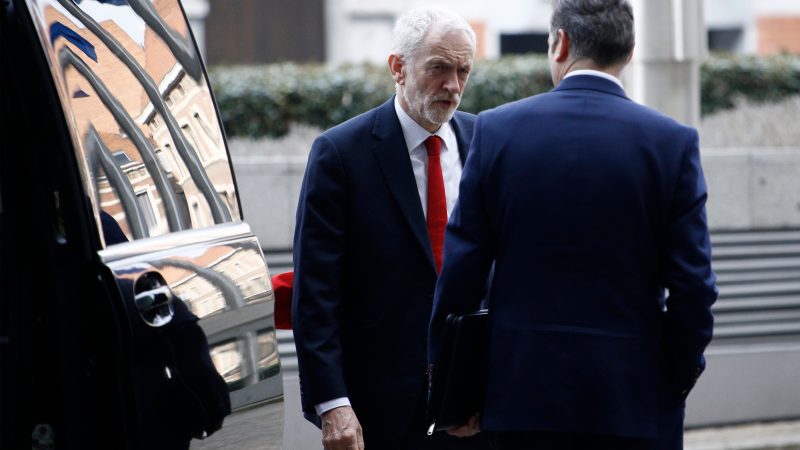
More than one in four Labour members would consider joining Jeremy Corbyn and Zarah Sultana’s new left-wing party, an exclusive poll for LabourList has revealed.
The poll, conducted by Survation, revealed that 28% of Labour members surveyed would consider leaving Labour for ‘Your Party’, while two-thirds said they would not join the new party.
Men were more likely to consider joining the party (31%), as well as those aged 45-54 (34%), those who joined the party around 2015 (44%), and members who backed Rebecca Long-Bailey in the 2020 leadership election (70%).
By region, members in the East of England were most likely to be considering leaving Labour for ‘Your Party’ (41%), while those in London were the least likely (17%).
It comes as the former Labour leader and the former Labour MP for Coventry South gear up for their fledgling party’s inaugural conference, due to be held in the autumn to determine a permanent name and its policies.
More than half of members fear ‘Your Party’ will increase chances of Reform/Tory government
More than half of members polled (51%) said they thought Corbyn and Sultana’s new party would take votes from Labour and increase the chances of a Reform or Conservative government, while 12% thought the party would predominantly take votes from the Greens and minor parties, having no impact on who forms the government.
Only three percent of those polled thought ‘Your Party’ could win enough votes to form their own government.
In a recent interview with LabourList, former Labour leader Neil Kinnock warned of the threat of a split progressive vote to Labour – and hit out at the new left-wing party.
“I’ve suggested in all comradeship that Corbyn’s outfit should be called the Farage Assistance Faction, or FAF, because they must know that the only place they can get votes is from people who would otherwise vote Labour.”
When asked how the party should respond to the potential threat of the new party, the majority of members polled (59%) said Labour should move to the left, while more than a third (35%) thought the party should move “further and faster” on its current agenda, with only two percent calling on Labour to move to the right.
Damian Lyons Lowe, chief executive of Survation, said: “‘Consideration’ of a new party is a softer measure than outright support, but these findings nevertheless reflect the residual sympathy for Jeremy Corbyn and frustration over his departure from Labour.
“The extent to which ‘Your Party’ becomes an electoral problem for Labour is an open question. The task of creating a viable new party is formidable, particularly given the policy differences likely among its founding MPs outside their shared stance on Gaza.
“As to the difference a new left party could make to Labour’s bid for a second term, much will depend on whether progressive-leaning voters tactically support Labour in constituencies where the contest is between Labour and Conservative or Reform candidates.
“If Labour is able to retain and attract progressive and centre-left voters ‒ and we are seeing continued seepage of support to both the Greens and the Liberal Democrats this parliament ‒ there is still a fighting chance for Labour to win a second term, despite the huge drop in first-choice support since the general election.”
Survation surveyed 1,021 readers of LabourList, the leading dedicated newsletter and news and comment website for Labour supporters, who also said they were Labour Party members between August 5 and August 9.
Data was weighted to the profile of party members by age, sex, region and 2020 Labour leadership vote, targets for which were derived from the British Election Study and the results of the 2020 leadership election.
Labour membership declines by 200,000 since Corbyn era
Luke O'Reilly 22nd August, 2025
Labour has lost 200,000 members since the end of the Corbyn era, according to the party’s own figures.
Membership has fallen to 333,235, from a peak of 532,046 at the end of 2019.
Even the party’s landslide general election victory did little to prevent the decline, with members down 37,215 over the course of 2024.
More than one in four Labour members would consider joining Jeremy Corbyn and Zarah Sultana’s new left-wing party, an exclusive poll for LabourList has revealed.
The poll, conducted by Survation, revealed that 28% of Labour members surveyed would consider leaving Labour for ‘Your Party’, while two-thirds said they would not join the new party.
Labour sources said the numbers tend to fluctuate between election cycles, but the party was proud to still be the largest political party in the UK.
GLOBAL CRISIS
UK
‘Young people are locked out of homeownership – bold action is needed
Homeownership is a distant dream for many people. For prospective first-time buyers, it’s often like being on a hamster wheel. They are working hard and saving as much as possible, yet barely moving closer to their goal. Is it any surprise that young people currently feel their country is failing them?
Homeownership among younger people in England has collapsed. The average age of a first-time buyer is now 34, up from 31 two decades ago. The proportion of households aged 25 to 34 owning their home is 39 per cent, down from the peak of 59 per cent in 2000.
Ultimately, this is due to house prices outstripping earnings. The average house price for a first-time buyer in 2024 was around five times average earnings – up from around 4 times average earnings two decades earlier. As a result, the Home Builders Federation estimate it would take the average earner 53 months to secure a deposit in England if every penny after bills was saved. This is an insurmountable barrier for those who don’t benefit from the wealth of parents or other family members.
But while fewer young people are homeowners, the desire to be a first-time buyer remains strong. According to the English Housing Survey, 71 per cent of young renting households expect to buy their own home at some point. The government must urgently tackle the barriers that are preventing this expectation of homeownership from becoming a reality. Otherwise, the country risks serious political consequences from successive generations being locked out of the benefits of homeownership in a country perceived to be failing them.
‘Many of the challenges are a direct consequence of Help to Buy’
However, there is no single or easy solution to helping first-time buyers onto the property ladder. Labour must learn from the failures of the Conservatives who thought quick fixes would solve a crisis that is decades in the making.
Their flagship ‘Help to Buy’ scheme was supposed to help first-time buyers buy a property with a lower deposit by lending up to 20 per cent of the cost of a new-build home. Ultimately this drove up prices, as it increased demand at a time when supply was inadequate. Indeed, many of the challenges for first-time buyers today are a direct consequence of ‘Help to Buy’.
The lesson from the Tories’ failure is that there is no long-term solution to helping people become first-time buyers that doesn’t include massively increasing housebuilding. The government’s 1.5m new homes target is, therefore, critical.
But while recent planning reforms will help, the government must go further to unlock hundreds of thousands of additional homes before the next election. And they cannot lose focus on quality, so that a rapid increase in housebuilding doesn’t lead to first-time buyers purchasing poor-quality, inadequate and unsuitable new homes.
‘This government must build more homes and make it easier to access a mortgage’
Moreover, increasing housebuilding will inevitably take time to have an impact. There are two more immediate steps that the government should take to help first time-buyers.
First, the government should require that lenders use a record of paying rent on time as evidence that mortgage repayments are affordable. Many individuals have clear evidence that they can afford regular payments, as they are spending far longer in the private rented sector than previous generations. They will often pay far more in rent than they would for a mortgage. The Financial Conduct Authority is currently reviewing lending rules, and this should set out how to open up access to mortgages in this way.
Second, the government should make it easier for people to save for a deposit. This would involve cutting the cost of living for young people, so a lower proportion of their income is going on rent and bills. But ministers should consider how to top up savings, particularly for those who lack access to the ‘bank of mum and dad’. If this was implemented alongside dramatically increased supply, this could help first-time buyers without forcing house prices up.
It will take a long time and a range of policies to make people’s dream of home ownership a reality and to convince young people that they have a stake in the future. But this government must take up that challenge by building more homes and making it easier to access a mortgage.
Ben Cooper is the Head of the Fabian Housing Centre.@BenCooper1995
A new book on Keir Starmer’s leadership is published today. Editor Mark Perryman introduces the book with this edited extract from it.
” The crisis consists precisely in the fact that the old is dying and the new cannot be born; in this interregnum a great variety of morbid symptoms appear.” Antonio Gramsci.
To start a book on Keir Starmer’s Labour Party and government with a quote of almost 100 years’ vintage from an imprisoned Italian communist is surely bordering on the intellectually perverse? Gramsci’s ideas had a certain appeal amongst a section of the British left intelligentsia through the 1970s and 1980s, but even that was 50-odd years ago.
So, a word of explanation and caution. There is an unhealthy habit of those who frame their politics in the words of centuries-old sages, Marx and Lenin in particular, to treat these founding texts as a kind of catechism, a religious order masquerading as revolutionary politics. That is not what is being suggested here.
Rather Gramsci’s idea of ‘symptom’ acts as a tool to help us develop and deepen our own understanding of this Keir Starmer ‘moment’. He is a Labour leader determined to extinguish all trace of the 2015-19 Corbynism experiment, leading the Party to end 14 years of Tory, with a little help from Nick Clegg, ‘progress’ via a landslide majority. He is a someone sparking both hopes, but also fears, of what this first Labour Prime Minister since the Blair-Brown era may or may not achieve in office.
Why ‘symptom’? The argument is that between the old and the new there’s a variety of ‘symptoms’, some negative but some positive. Symptom not in the sense of a disease, but a sign of we know not what comes next. In the post-2024 General Election issue of the journal Soundings, John Clarke echoed this approach by pointing out how multifaceted these ‘symptoms’ are. As a result any likely outcomes are likely to be the same:
“As a starting point, Gramsci’s observations generate a set of difficult questions about the shifting alignments of consent and force; about who the ‘great masses’ are (and who they think they are); about the spatial and temporal conditions of the ‘interregnum’ (and how to address its ‘morbid symptoms’); and about how the instabilities of the interregnum might be resolved.”
John rather neatly sums up our daily lived experience of these symptoms: “from the shit in our rivers and seas through to the collapse of collective infrastructures, including welfare and care.”
Every day since July 4th 2024, these symptoms in some shape or form have shaped the Starmer government and how it has impacted upon us.
First, whatever their differences, it was surely significant that Starmer and Reeves in at least one, crucial, direction echoed Corbyn and McDonnell via the centrality they gave to a green economics of sufficient magnitude to reverse the increasingly imminent climate emergency. The Corbynite ‘Green New Deal’ was replaced by ‘Great British Energy’. But at every twist and turn of actual implementation they have beaten a headlong retreat to the soundtrack of their mantra, ‘growth’.
Second, Gaza marked out another very obvious dividing line, self-evidently obvious in Starmer’s instant response to the horrors inflicted by Hamas on October 7th 2023 that “Israel has a right to defend itself.” It’s a right he hasn’t once, before or after the Hamas atrocity, extended to Palestine, Lebanon or Iran. And in the process he has established a dividing line that stretches considerably wider than what remains of the Corbynite left. Because this is a moment like Guernica, Vietnam, Soweto and Iraq that is defining a political generation stretching way beyond any preconceived definition of the ‘left’. And Starmer has ended up positioning himself and Labour in opposition to those defined in this way by Gaza.
Third is the well-publicised strategy of recapturing Labour voters who deserted Labour in 2019, when immigration and asylum were identified as the key issues to make headway on. Fine, but heaven forbid this might mean making the argument that immigration is a foundational principle for Britain to have a functional economy and the social infrastructure we all depend upon. Or that asylum is a fundamental, human right, at least it should be. And when Jewish refugees who sought it in the 1930s escaping from Nazi Germany were refused entry because of a demonisation eerily similar to today, it didn’t end happily: rather it ended in the gas chambers Starmer very publicly visited ahead of the 2025 anniversary of the liberation of Auschwitz.
Labour seeks to trump the Tories’ ‘Stop the Boats’ with ‘Smash the Criminal Gangs’. No one should romanticise the trade that exploits the desperation of those seeking to escape oppressive regimes, war and famine, but what kind of argument is Labour making when it cannot bring itself to explain why people seek asylum and the consequences for them when it is denied? Having an argument: isn’t that what anything resembling a meaningful politics should consist of?
Fourth, ‘the bitterness of popular conflicts’ takes another, popular, form in the so-called ‘culture wars’, most obviously around transgender identity. It’s a subject seemingly almost everyone actively involved in politics, and beyond too, has a position on, usually entrenched and bitterly opposed to those who hold a different point of view, labelled as either transphobic or misogynist. I say “almost everyone”: prominent exceptions include Keir Starmer and the Labour Party, presumably in the hope this troublesome issue will go away. It won’t.
Fifth, for the ‘multiplication of forms of dissent’, a revived Scottish National Party and Plaid Cymru cannot be ruled out. Meanwhile there is Sinn Fein’s increasing dominance of Northern Irish politics. All this points to how difficult it remains for a Unionist Labour Party, despite the landslide, to prevent the irresistible break-up of Britain. And as for England, despite all of Keir’s occasional appearances in an England shirt to cheer on team, and country, Reform UK have successfully positioned themselves as the party of English nationalism.
Add this list to John Clarke’s and together these are symptoms that spell F-R-A-C-T-U-R-E.
Mark Perryman is the editor of The Starmer Symptom. Contributors include Clive Lewis, Danny Dorling, Emma Burnell, Gargi Bhattacharyya, James Meadway, Hilary Wainwright Jeremy Gilbert, Neal Lawson, Phil Burton-Cartledge and Yasmin Alibhai-Brown.
Special Offer: just £11.89 via Labour Hub instead of the usual price £16.99. Use coupon code ‘STARMER 30’ at Pluto Press here
Heathrow’s runway folly: billions for business as usual, while our communities and planet pay the price
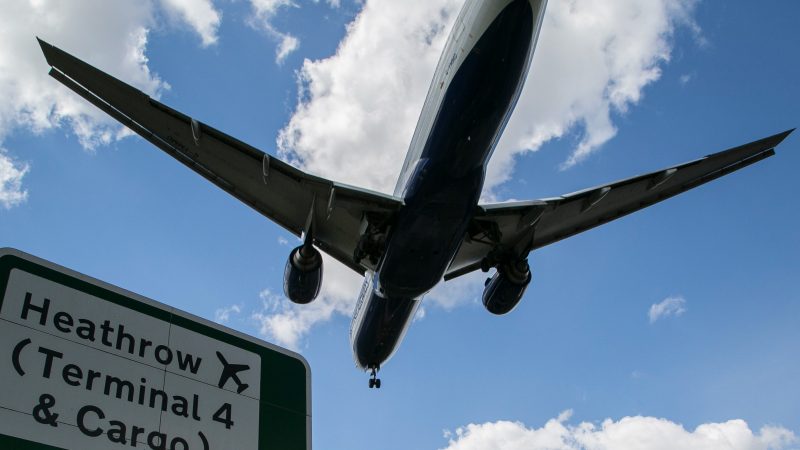
The proposed expansion of Heathrow Airport stands as a defining test of this Government’s commitment to people, place, and the planet.
Cost – who pays for it?
The figures alone are mind-boggling, with Heathrow’s proposal now totalling £49bn – without the contribution required for new road and rail connections. This megaproject could cost three times what the airport’s entire current asset base is worth. This is before we account for the eye-watering £17 billion in existing debt that Heathrow is already servicing.
There remains a big question about whether Heathrow can even afford a third runway? The latest analysis from S&P suggests not, with expansion requiring a massive new capital injection from shareholders to make even a £25 billion build possible. Yet Heathrow’s own business plan for 2027–2031 includes only a £2 billion capital injection — the rest will be paid for by borrowing. This means a whopping 17% hike in landing charges, that will be passed onto the airlines and will result in ordinary hard-working passengers footing the bill.
Even the airlines that use the airport aren’t on board. They know the real financial burden will fall on them under current regulatory models and will force them to increase fares for the travelling public. So why is the Government pushing for expansion when the industry itself is so unenthusiastic?
To make matters worse, the runway would require major upgrades to the road and rail network at an estimated public cost of £5-15 billion (in 2018 prices). Heathrow has said it will pay for the runway itself but has not ruled out seeking additional public funds for these vital surface access improvements. Of course, any public funding spent in support of Heathrow expansion would reduce available capital investment for other potential projects like the Bakerloo line extension or Crossrail 2. Surely such funds would be much better spent elsewhere around the country spreading economic opportunity to all corners of the UK?
Destruction of local communities and disruption to local transport networks
But the true cost of this vanity project is the irreversible devastation to communities and ecosystems. Nearly 800 homes will be destroyed outright, with another 4,750 rendered uninhabitable due to noise and pollution from the proximity of the runway.
Communities that have thrived for generations, villages like Sipson and Harmondsworth, stand to be wiped off the map, families forced to leave, and neighborhoods torn apart.
Local families also face the prospect of the M25 motorway carved and tunnelled beneath their feet — an engineering folly that will disrupt the daily lives of 200,000 commuters at one of the UK’s busiest interchange points. The knock-on impact of the local road network from construction still remains unassessed by Government.
According to analysis by Transport for London, a third runway will increase delays at junctions and result in slower average speeds on local road networks, incurring costs and potentially increasing emissions. An expanded Heathrow will result in 170,000 additional daily passenger and staff trips compared to today. An additional 18,000 freight trips per annum are also forecast. So, expansion brings a significant risk that the public-funded improvements to the transport network over the past two decades will be wiped out entirely.
Devastating environmental impacts
Perhaps most fundamentally, a third runway would drive up the UK’s carbon emissions, threatening not only local but global efforts to mitigate climate change. Heathrow is already the single biggest source of carbon emissions in the UK and expansion will add an extra seven megatonnes of CO2 per year.
Government climate advisers have warned against additional airport capacity until emissions are demonstrably falling—a warning that, so far, has been ignored. The Department for Trade’s own Jet Zero Strategy effectively admits that it’s not possible to meet the Climate Change Committee’s recommendation for keeping aircraft emissions within the limits of the Climate Change Act while building a third runway, but seems to have no answer on how it will account for this. What is clear is that any increased emissions at Heathrow will make it far more difficult for the country to meet its obligations under the Paris Agreement, undermining the UK’s international credibility.
Further, neither Heathrow nor the Government have comprehensively considered the non-CO2 impacts from Heathrow’s expansion proposals. The latest academic research shows that whilst there are a lot of uncertainties on how to measure such impacts, it is likely that other greenhouse gases from aircraft have a trebling effect in terms of global warming.
A third runway would bring up to 270,000 additional flights each year – that’s 756 more a day – which is the same number that currently arrive and depart at Gatwick! Expansion on this scale would make London by far the most overflown city in Europe. More than 700,000 people are already exposed to harmful levels of aircraft noise under the Heathrow flight paths – that’s equivalent to 28% of all people across Europe that are impacted by noise pollution and a higher total than Heathrow’s five biggest European competitors combined.
A third runway would likely double that figure, exacerbating the physical and mental health problems this causes. It would result in many communities experiencing constant aircraft noise for the first time, possibly up to 13 hours a day and communities currently overflown losing several hours of much needed respite every day.
Expansion would also mean that hundreds of thousands more people will suffer under increased road congestion and the toxic burden of worsening air pollution. In fact, credible estimates from the Mayor of London’s 2016 report suggest the health impacts on the NHS over the coming decades could hit £25 billion – closer to £34bn when accounting for inflation.
If air quality limits are to be met, then it will rely on measures to be implemented by the Mayor of London. Such measures will of course have been designed to improve the public health of Londoners, not for the benefits to be undermined by increased pollution from an expanded Heathrow.
And what about our irreplaceable natural heritage? Five rivers, part of the vital, ancient network of the Bucks & Herts Chilterns’ precious chalk streams, would be diverted, culverted, or lost. Over 1,200 hectares of Green Belt across West London, Buckinghamshire and Hertfordshire would be sacrificed — green spaces that are meant as a bulwark for nature and a lifeline for city dwellers in a warming world.
Expansion is not needed
We must question if the expansion is even needed. Heathrow’s own data show a persistent decline in business traffic: down 20% since 2019 and showing no sign of recovery in their forward planning. The airport is losing its hub status, with transfer traffic falling from 27.4% in 2012 to just 21.4% today — and still in decline. The future projected growth is primarily leisure flights, and this growth will help to deepen the tourism deficit which current sits at around £42bn per annum.
In a climate and biodiversity crisis, does anyone believe we should spend tens of billions to funnel more tourists onto flights, when smaller, smarter investments can help transform more parts of the country in a sustainable manner?
Standing up for people and planet
An expansion of this magnitude should not, and cannot, be rushed through to suit short-term political expediency. The facts show there’s no justification for this economic, social, or environmental vandalism. The money, the land, the health and the very quality of life for millions could all be lost for no discernible national benefit – just the opportunity for a foreign owned corporate entity to squeeze a few more holidaymakers through an already overstretched airport, charging them more for the privilege and facilitating the export of cash that could be spent in the UK.
Now is our moment to demand a future-fit transport policy — one that puts people and planet before polluters and profiteers. This is not just about one runway. It’s about where we draw the line. This expansion isn’t needed. It isn’t affordable. And it isn’t right.
The health of our communities and planet are worth far more than another runway for Heathrow. So, let’s stand up, as campaigners and as citizens, and demand better for Britain. Let’s say no to another runway for Heathrow. Let’s say yes to sustainable, equitable investment in public infrastructure that supports our communities, strengthens our economy, and protects our environment for generations to come.
Image: Thousands say ‘No’ to Heathrow expansion. https://www.flickr.com/photos/hacan/3666970579Attribution: HACAN/hacan.org.uk Licence: Attribution-NoDerivs 2.0 Generic CC BY-ND 2.0 Deed
More than half of Labour members oppose Heathrow expansion, poll reveals
Luke O'Reilly 20th August, 2025
:
A majority of Labour members oppose the expansion of Heathrow Airport, exclusive polling by Survation for LabourList has revealed.
Asked to what extent, if at all, they supported or opposed the expansion, 52% said they either somewhat or strongly opposed it. This compared to just 27% who said they supported the expansion.
A further 19% said they neither supported nor opposed it, and two percent answered “don’t know”.
Opposition to the expansion was strongest among those aged 65 and older, with a net support of -39. Support for the expansion was highest among the 18-24 age group at 42%, compared to 40% opposed.
Opposition was also strongest among members who voted for Rebecca Long-Bailey in the leadership election, at 75%.
The expansion has proven controversial. It has been mooted for years, with little movement on the issue by successive Tory governments.
That was until Labour put the project at the centre of its growth agendlaboa, with Rachel Reeves promising that building a third runway would “unlock further growth” and “boost investment”.
Not everyone in the cabinet was happy about the announcement, however, with rumours swirling that Ed Miliband would resign over the issue.
London mayor Sadiq Khan also expressed dismay at the expansion, threatening to take legal action against the government over the matter.
And it’s clear the members don’t support it either, with the issue becoming yet another wedge between the leadership and the party’s rank and file.
Despite this, Miliband has remained in post, and the expansion looks set to push ahead, despite the opposition.
Survation surveyed 1,021 readers of LabourList, the leading dedicated newsletter and news and comment website for Labour supporters, who also said they were Labour Party members between August 5 and August 9.
Data was weighted to the profile of party members by age, sex, region and 2020 Labour leadership vote, targets for which were derived from the British Election Study and the results of the 2020 leadership election.
‘Heathrow third runway is the wrong answer to the wrong question’
Andy Slaughter 20th August, 2025
Photo: Zuzanna Walewska/Shutterstock
My long-standing opposition to expansion at Heathrow has been a cornerstone of my twenty years as the MP for Hammersmith and as Leader of the Council before that. The arguments for a third runway claim to support growth and national interest, yet fundamentally ignore the realities of our climate obligations, public health, and the long-term wellbeing of communities like my constituents.
The so-called economic benefits have been consistently overstated while the costs to public health, residents, and the public purse remain underplayed. Let us be clear: Heathrow expansion is not essential to London’s economy. London already attracts more business travellers and tourists each year than any other city in the world, and most have no strong preference for which airport they use.
Further, Heathrow’s own data show a persistent decline in business traffic: down 20 percent since 2019 and showing no sign of recovery in their forward planning. The future projected growth is primarily leisure flights and this only will help to deepen the tourism deficit which currently sits at around £43bn per annum.
‘Costs will inevitably be passed onto ordinary passengers’
Recent analysis from S&P suggests that Heathrow will struggle to afford expansion. They conclude that a third runway would require an unprecedented flood of capital from shareholders to make the financial case viable.
However, Heathrow’s own business plan for the next five-year regulatory period includes just £2 billion of actual shareholder capital out of a £10bn investment. The rest will be raised through borrowing and the debt repaid through an eye-watering 17% increase in landing charges to airlines.
Such costs are inevitably passed straight onto ordinary passengers. No wonder the airlines are not supportive of the current proposals and recognise expansion cannot take place at any cost.
To make matters worse, expansion at Heathrow would require major upgrades to the road and rail network at an estimated public cost of £5–15 billion (in 2018 prices). Heathrow has said it will pay for the runway itself but has not ruled out seeking additional public funds for these vital surface access improvements—funds that could be much better spent on other public transport projects in London or spread across the regions of the UK.
‘Expansion could double number of people exposed to harmful aircraft noise’
It is vital that we do not forget about the human cost in all this. At least 781 homes will be bulldozed under Heathrow’s proposal. Another 4,750 could become uninhabitable thanks to their proximity to the new runway. A third runway will increase delays at junctions and result in slower average speeds on local road networks, incurring costs and potentially increasing emissions.
Local communities under the flightpath already endure unacceptable levels of noise and air pollution, with devastating impacts on health and quality of life. Yet, a third runway would bring up to 270,000 additional flights each year, that’s 756 more every day – which is the same number that currently arrive and depart at Gatwick! 28% of all people across Europe that are impacted by noise pollution already live under Heathrow’s flight paths, a higher total than Heathrow’s five biggest European competitors combined. Expansion of flight numbers at the scale proposed will potentially double the number of people exposed to the harmful effects of aircraft noise.
‘Framing opposition as ‘blockers’ is unhelpful’
Aviation is already one of the fastest-growing contributors to greenhouse gas emissions and the potential for alternative aviation fuels to reduce emissions is vastly outweighed by the sector’s projected growth. No credible climate test can be passed by any new runway at Heathrow, and to claim otherwise is to wish away both science and the legal targets this Government wishes to uphold.
Framing opposition to major projects or developments, whether from local residents, environmental experts or elected representatives as “blockers” is unhelpful. Genuine and long-term growth will only be achieved when we invest in a fully integrated public transport system, not by repeating the old mistakes of carbon-intensive mega-projects. Governments and scheme promoters should not ignore considered objections that advocate long-term sustainability.
The Government’s current position appears at odds with its own policy tests, which demanded that any airport expansion deliver on climate, air quality and noise, nationwide connectivity, and value for money. A third runway unequivocally fails on all these counts. Heathrow expansion is an outdated answer to the wrong question. Britain’s future prosperity depends not on more tarmac, but on leadership that prioritises sustainability, community well-being, and genuine, inclusive economic renewal
FASCISTS Protest in UK against asylum seeker housing continue, counter-protests arise Copyright Ben Birchall/PA By euronews with AP Published on 23/08/2025
The government is legally obligated to house asylum-seekers. Using hotels to do so had been a marginal issue until 2020, when the number of asylum-seekers increased sharply and the then-Conservative government had to find new ways to house them.
Protesters took to the streets across the UK on Saturday including in the city of Liverpool to demonstrate against hotels housing asylum-seekers.
A number of protests under the Abolish Asylum System slogan, coined by right-wing political parties, were also set to take place in other cities including in Bristol, Newcastle, and London.
In Liverpool, a counter-protest organised by Stand Up To Racism was also held.
Police could also be seen leading away protesters from the Abolish Asylum System protest and pushing back demonstrators from the counter protest
The dilemma of how to house asylum-seekers in Britain got more challenging for the government after a landmark court ruling this week motivated opponents to fight hotels used as accommodation.
Politicians on the right capitalized on a temporary injunction that blocked housing asylum-seekers in a hotel in Epping, on the outskirts of London, to encourage other communities to also go to court.
Legal obligation to house asylum-seekers
The issue is at the heart of a heated public debate over how to control unauthorized immigration that has bedevilled countries across the West as an influx of migrants seeking a better life as they flee war-torn countries, poverty, regions wracked by climate change or political persecution.
In the UK, the debate has focused on the arrival of migrants crossing the English Channel in overloaded boats run by smugglers and escalating tensions over housing thousands of asylum-seekers at government expense around the country.
The government is legally obligated to house asylum-seekers. Using hotels to do so had been a marginal issue until 2020, when the number of asylum-seekers increased sharply and the then-Conservative government had to find new ways to house them.
There have been more than 27,000 unauthorized arrivals so far this year, nearly 50% higher than at the same point last year and ahead of the number at this time of year in 2022, when a record 45,755 came ashore.
The number of asylum-seekers housed in hotels stood at just over 32,000 at the end of June, according to Home Office figures released Thursday. That figure was up 8% from about 29,500 a year earlier but far below the peak of more than 56,000 in September 2023.
A total of 111,084 people applied for asylum in the year to June 2025, the highest number for any 12-month period since current records began in 2001.
In May, the National Audit Office said those temporarily living in hotels accounted for 35% of all people in asylum accommodation.
“The pernicious and insidious currents of racism and hatred underlying these protests are glaring evidence of a failing system. The responsibility to end the divisive politics, racist rhetoric and demonising language of the past is yours."
Refugee and asylum rights organisations across the UK are ramping up their response to what they describe as a rising tide of “racist rhetoric” from politicians and media outlets, in the wake of escalating tensions surrounding the use of hotels to house asylum seekers.
The move comes after weeks of unrest in Epping, Essex, where an asylum seeker was charged with sexually assaulting a 14-year-old girl. The incident drew large crowds, including far-right agitators, to protest outside the hotel where asylum seekers are being housed, raising fears about community safety and the threat of violent backlash against migrants.
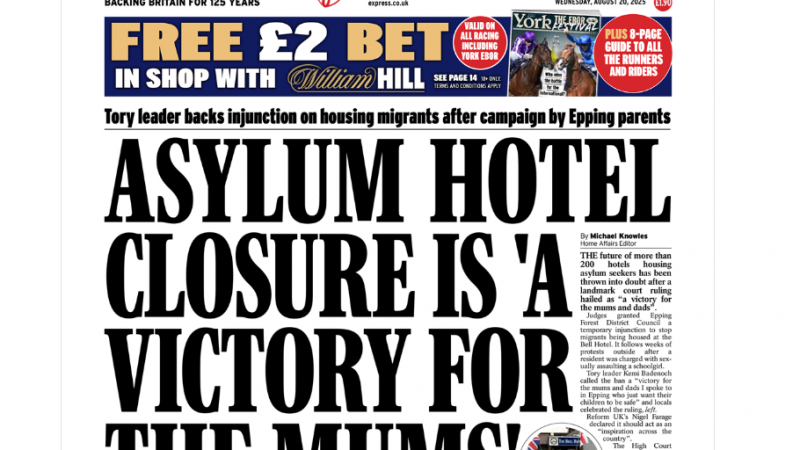
The media has been quick to seize on the controversy. Warnings have been made that headlines like the Daily Mail’s August 20 front page, “Labour’s migrant hotels policy in disarray,” and the Express declaring the closure of one Essex hotel a “victory for the mums,” have only fuelled public anger.
Critics have also been quick to point out the inaccuracy of attributing the hotel policy to Labour, noting that the number of so-called “asylum hotels” actually peaked under Conservative leadership, with 402 in operation under Rishi Sunak, compared to 210 now.
In response to the antagonistic media and political discourse, Refugee Action has launched a petition calling for an end to language that they argue dehumanises migrants and fuels racial hatred. Their petition reads:
“We, the signatories to this petition, demand an end to the danger your words create for refugees, Muslims, migrants, Black and Brown people, and racialised communities. Seeking asylum is legal. Stop insinuating people have done anything wrong by asking the UK for protection. Make no excuses for racist violence. Call it what it is. When Muslims are targeted, call it Islamophobia. Abandon dehumanising words and slogans. ‘Stop the boats’, ‘Illegal migrant’, ‘Swarms’, ‘We want our country back’ – when your words are used by violent racists it is time to reconsider them. Stop promoting the hostile and racist policies that divide our communities. Welcome people seeking safety with the respect and dignity they deserve.”
In a further show of solidarity, more than 200 refugee and human rights organisations signed an open letter addressed to UK political leaders. Coordinated by Together With Refugees, which is the largest pro-refugee coalition in British history, the letter condemns recent anti-refugee protests and calls for an end to the ‘divisive politics’ that have led to a hostile climate for people seeking safety.
The open letter has been signed by 213 organisations, including Amnesty International UK, Care4Calais, Oxfam, Refugee Action, Freedom from Torture, and Islamic Relief. It states: “Anti-refugee protests across the country have been distressing to witness, with echoes of last summer’s riots making them all the more alarming.
“The pernicious and insidious currents of racism and hatred underlying these protests are glaring evidence of a failing system. The responsibility to end the divisive politics, racist rhetoric and demonising language of the past is yours. Only then will you bring unity instead of division and cohesion rather than hate.”
The letter concludes: “For those who need our compassion to be confronted with further torment here in the UK is shocking. But the outpouring of support from communities condemning the hatred is a powerful reminder that these views do not represent the vast majority. Today we stand in solidarity with those targeted, because this is what represents our country, this is who we are.”
Together With Refugees recently hosted its Welcome Weekend, a nationwide initiative designed to offer an alternative narrative, one of hospitality, empathy, and solidarity. Hundreds of events were held across the UK, with communities putting up welcome posters, sharing refugee stories, and calling for a new, fairer asylum system.
The coalition is now urging political leaders to adopt a ‘fair new plan for refugees,’ one that honours the UK’s international obligations, opens safe and legal routes to asylum, and tackles the global root causes of displacement with compassion and cooperation.
Britain First’s ‘March for Remigration’ led by convicted people smuggler, Hope not Hate reveals
Lee Twamley, photographed at the front of Britain First’s “March for Remigration” in Manchester this month, has served prison time for trying to smuggle Vietnamese migrants into the UK.
Far-right Britain First’s ‘March for Remigration’ in Manchester, in which the extremist group called for mass deportations, was led by a convicted people smuggler.
Anti-fascist campaign group Hope Not Hate reports that ‘Lee Twamley, photographed at the front of Britain First’s “March for Remigration” in Manchester this month, has served prison time for trying to smuggle Vietnamese migrants into the UK”.
A reminder that Britain First portrays itself not only as anti-immigration but also as tough on law and order.
Under the slogan “March for Remigration”, a euphemism for mass deportations, the group has held a series of events that have brought an assortment of neo-Nazis, misogynists, crackpots and convicts onto the streets of Nuneaton, Birmingham and, on 2 August, Manchester.
Twamley, was photographed marching alongside Britain First leaders Paul Golding and Ashlea Simon at the forefront of the Manchester event, holding a Union Jack flag aloft.
Hope not Hate reveals: “Twamley was previously jailed for 20 months as part of a Salford gang that tried to smuggle 11 Vietnamese migrants across the Channel to pay off drug debts.”
(Picture credit: Hope not Hate)
Basit Mahmood is editor of Left Foot Forward
Study finds boycott of the Sun made the people of Liverpool more left-wing
“The results indicate to me that these shifts in political attitudes began during the boycott.”
The decades-long boycott of the Sun in Liverpool has long been seen as a moral and cultural protest, but has it also changed the city’s political views?
That was the question Lucas Paulo da Silva of Trinity College Dublin set out to explore in a recent study, with the findings published in the Conversation. Drawing on data spanning two decades and over 12,000 respondents, da Silva examined how the boycott of the Sun, dubbed “the Scum” by many locals, may have influenced the city’s political attitudes over time.
The boycott began in the aftermath of the Hillsborough disaster on April 15, 1989, when a fatal crush at the FA Cup semi-final between Liverpool FC and Nottingham Forest led to the deaths of 97 people and injuries to hundreds more. The Murdoch-owned Sun published a series of false and inflammatory claims blaming Liverpool fans for the tragedy. Four days after the disaster, it ran a front-page splash, headlined ‘The Truth’, based on allegations from unnamed South Yorkshire police sources that were later disproved. The report laid the blame on Liverpool supporters, claiming they had forced their way into the stand, stole from the dead and urinated on bodies.
In response, many Merseyside residents and local newsagents initiated a boycott of the paper that continues to this day. Despite official apologies in 2004, 2012, and 2016, the Sun’s circulation in Liverpool has remained a fraction of what it once was.
According to Da Silva’s study, the boycott had a measurable political impact. His findings suggest that former Sun readers in Liverpool began shifting leftward, increasing their support for the Labour Party. The paper was often replaced by more left-leaning or neutral titles, particularly the Daily Mirror.
Da Silva’s research focused on the period between 1983 and 2004, a time also marked by other major political and economic shifts, most notably the Thatcher-era policies of de-industrialisation and cuts to public services. Liverpool, already struggling with poverty and unemployment, became a stronghold for the Labour Party’s Militant faction, which controlled the city council from 1983 to 1986.
“For many in Liverpool those policies of that era were to blame for extremes of poverty and deprivation in the area,” writes Da Silva.
To isolate the specific impact of the Sun boycott, da Silva compared political attitudes among the paper’s former core readership in Liverpool (those directly affected by the boycott) with attitudes among non-Sun readers in the city and in comparable northern regions. He also examined whether political shifts had already begun before the boycott, which would have pointed to other causes.
“The results indicate to me that these shifts in political attitudes began during the boycott,” he writes, adding:
“The period also saw those former Sun readers in the city adopt more opinions traditionally regarded as left-wing, including being in favour of increasing the power of trade unions.”
Notably, support for the Labour Party increased significantly among the Sun’s former core audience in Liverpool, even as it slightly declined among others in the city and among those not exposed to the boycott. These changes persisted from the start of the boycott in 1989 until 1996, before the Sun famously endorsed Labour, and continued until at least 2004, when Da Silva’s dataset ends.
He concludes by pointing to a broader implication of his findings.
“The Sun famously ran the 1992 headline “It’s The Sun Wot Won It”, claiming credit for the Conservative general election victory. Clearly, newspaper publishers then felt they could influence political views.
“But perhaps a more interesting finding from my study is how this may happen. My results suggest to me that media influences how people perceive party positions. This is something that governments, publishers, and critically voters should take into account if they want to address the effects of media on elections.”