OPINION
The bureaucratic trainwreck that sabotaged Mississippi’s election

Sarah Warnock/USA Today Network via REUTERS.
Sarah Warnock/USA Today Network via REUTERS.
November 07, 2026
ALTERNET
Elections always provide loads of interesting tidbits about people’s lives or how we choose to live.
In Mississippi, where we are seeing living proof that every vote counts, it turns out that this needed reliance on tens of thousands of provisional “affidavit” votes by individuals who showed up at the local voting precinct only to find they were not listed as authorized voters. That happened because the state had contracted with a credit bureau, of all things, to verify current addresses.
As Democracy Docket tells the tale, Mississippi made thousands of valid voters inactive ahead of the election that has Democratic challenger Scott Collum now about 2,400 votes ahead of Republican Sen. Cindy Hyde-Smith. Since Mississippi has no recount law, the outcome will depend on the counting of thousands of provisional ballots filed in local county offices, delaying the vote outcome,
It turns out that the Republican secretary of state’s contract with Experian, a global credit reporting agency whose data Mississippi Today has been described as riddled with errors threw thousands of voters into “inactive” status in the months leading up to the general election. The contract was intended to keep voter registration lists up to date, since people move all the time without updating their registration.
There is nothing illegal about any of this, just inane thinking.
Voters Didn’t Know
Most affected voters heard nothing about their status change and turned up at voting booths only to learn that they were no longer listed as registered voters. Rather than a normal ballot, they were handed an “affidavit” document recording their choices as well as a declaration of identification.
As evidence of errors in the credit bureau work, Experian sent communication to update or fix the registration to wrong addresses. Apparently, it’s up to individuals to check on their status.
In short, all the fuss about a virtual tie vote in Mississippi’s U.S. Senate race was avoidable without the fervor to hire an outside firm that never checked on the listings to “clean up” the voter registrations.
Instead, we’re sitting around waiting for 82 local counties to count these provisional ballots from people who have been on the same voter registration rolls for 20 or 30 years by hand – under the watchful eye of lawyers for both major parties and probably federal monitors – to decide just how big a Democratic majority will be in the U.S. Senate.
Just why a state would pay a credit bureau to verify voter listings without doing any actual verification, notification or updating is a bit of a mystery.
It’s not an inconsequential number of ballots. In DeSoto County, 15,000 were removed as active voters between the primary and general election, says Mississippi Today. Jackson County lost 14,063 and Harrison County 28,291. For many voters showing up at the polls to find themselves, well, missing, it was a shock. In all, there were upwards of 230,000 provisional ballots with 10,000 to 15,000 outstanding.
Republican Secretary of State Michael Watson defended the inactivations as a “cornerstone of election integrity,” adding in a social media post” “We’re getting multiple calls about people not showing up as active voters, so we wanted to share a few details.” Watson said the state sends the credit info to counties, which are supposed to verify it before updating the lists. “Thankfully, affidavit voting is used to catch any errors or those who live in the same county but forgot to update their info.” He said the “extra few minutes” it takes a voter to vote provisionally are “well worth the election integrity added by having cleaner voter rolls.”
The Checking
So, election canvassing boards in each will review all affidavit votes to check them against existing voter files for those deemed “inactive” as well as their preference in the Senate race. If officials are relying on the already faulty Experian data to cross-check voter files, aren’t more errors almost certain?
“Credit bureau data was never intended to be used to maintain voter rolls, and using the wrong data for the wrong purpose can lead to serious harm. In this case, Mississippi undermined access to voting, a fundamental right, by inexplicably using the data broker Experian’s data to ostensibly maintain voter rolls,” Center for Democracy & Technology’s Sydney Saubestre said.
Apart from all else, election officials must verify that the provisional ballots were properly signed by the precinct poll manager and that the voter provided voter identification within five business days.
Of course, none of this would have emerged if the contest had been a blowout.
Terry H. Schwadron retired as a senior editor at The New York Times, Deputy Managing Editor at The Los Angeles Times and leadership jobs at The Providence (RI) Journal-Bulletin. He was part of a Pulitzer Gold Medal team in Los Angeles, and his team part of several Pulitzers in New York.
“Mississippi has never been a lost cause,” said Colom, who could be the state’s first Black senator since Reconstruction. “We’ve been a betrayed cause.”
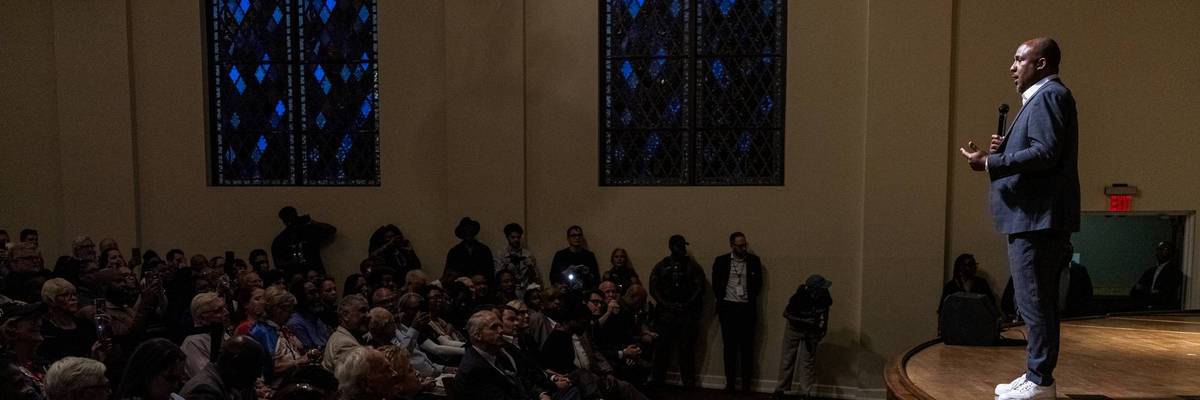
Democratic US Senate candidate Scott Colom speaks at a campaign rally on October 30, 2026, in Tupelo, Mississippi. Colom ran against incumbent Republican US Sen. Cindy Hyde-Smith in Tuesday’s midterm elections.
(Photo by Brad Vest/Getty Images)
Stephen Prager
Nov 04, 2026
COMMON DREAMS
Scott Colom is on the verge of a historic upset in Mississippi, where he could become the state’s first Democrat elected to the US Senate in more than four decades.
As of Wednesday afternoon, Decision Desk HQ showed Colom, a Black prosecutor and criminal justice reform advocate, holding a razor-thin margin of 1,864 votes over Republican Sen. Cindy Hyde-Smith with more than 95% of ballots counted.
Even on a night when Democrats clobbered the GOP up and down the map and won decisively in states as red as Texas, South Carolina, Kansas, and Iowa, very few analysts believed Mississippi—where President Donald Trump won by nearly 23 points in 2024—would be competitive, let alone a nail-biter that dragged into the next day.
But NBC election analyst Steve Kornacki explained Wednesday morning that with thousands of votes left to count in overwhelmingly Democratic Hinds County, “Colom could absolutely win this.”
In a 5-4 decision that now looms large, the US Supreme Court shot down Republican efforts to stop the counting of mail-in ballots postmarked on or before Election Day that arrive afterward. Those ballots, which can continue arriving until November 10, may ultimately decide the election.
Even if Colom falls short, his strong showing was evidence of what the NAACP, the nation’s oldest civil rights organization, described as “historic voter turnout” in Black communities, in response to Republicans’ attack on the Voting Rights Act.
Following the Supreme Court’s Louisiana v. Callais decision earlier this year, several GOP-controlled states, including those in the Deep South, moved to redraw congressional and state legislative districts in ways that voting rights advocates warned would dilute Black voting power.
On the campaign trail, Colom described Callais as “a threat to our democracy” and said Republican Gov. Tate Reeves, who proposed legislative maps that would have drawn Black lawmakers out of their districts, was seeking to stop Black voters from “being able to pick leaders they want.”
When the court’s conservatives kneecapped the Voting Rights Act, they inspired a fierce backlash among Black voters across the South,“ explained reporter Jim Saksa in an analysis for Democracy Docket. ”Massive Black turnout helped Democrats coast to victory in Georgia and made the Senate races in Mississippi and Louisiana the tightest seen in decades.“
Voter turnout in Mississippi is on pace to be about 40% higher than in the last midterm election in 2022. In majority-Black Hinds County, which contains Jackson, unofficial results showed nearly 76,500 votes for the two leading US Senate candidates alone, about 44% more than the total number of ballots cast four years ago.
“The story of this election is not just about who won,” said Dominik Whitehead, chief of field for the NAACP. “It’s about the Black wave of voters who understood what was at stake and made their voices heard.”
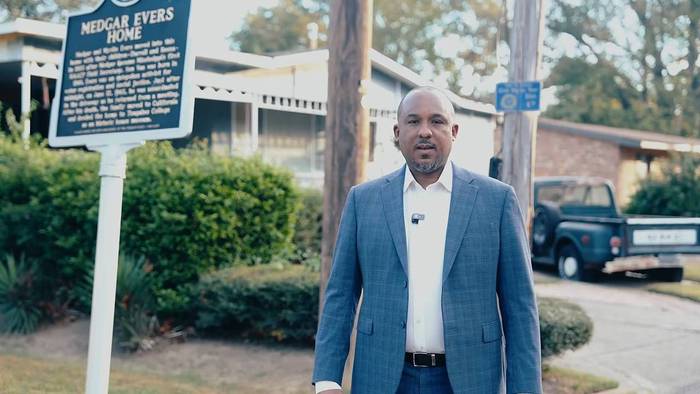
Democratic US Senate candidate Scott Colom of Mississippi stands outside the home of slain civil rights leader Medgar Evers in Jackson, Mississippi, in a video posted on November 1, 2026. (Screenshot from a video by Scott Colom)
Colom didn’t have to water down his platform much to achieve tremendous gains, even in a deep-red state. As political strategist Paul Hilder explained, he “ran on a ‘commonsense’ economic populist platform aimed at daily life: gas, groceries, healthcare, and closing hospitals, plus Medicaid expansion.”
In the nation’s poorest state, where nearly 1 in 5 residents rely on Medicaid or the Children’s Health Insurance Program, this message was potent. It was especially effective against Hyde-Smith, who has comfortably won her previous elections and was relentlessly criticized for dismissing voters’ concerns about high prices.
For example, in DeSoto County, which Trump carried by 24 points in 2024, Colom led Hyde-Smith by more than six points in early returns.
“[Colom] won many switchers, and the Republican vote collapsed,” Hilder said. “Swing voters are more volatile than ever, especially when they’re economically hard-pressed. They respond to common sense, and they’ve decided Trump and the Republicans are not on their side.”
Mississippi has not elected a Democrat to the US Senate since Sen. John C. Stennis, a conservative segregationist, won his seventh term in 1982. And although it has the highest proportion of Black residents of any US state, Mississippi has not sent a Black senator to Washington since Reconstruction, when Republican Blanche K. Bruce, who was born into slavery, was elected by the state Legislature.
Colom told NPR last week he’s always believed change was possible and that it has failed to materialize only because of neglect by national Democrats, who have long written the state off as unwinnable.
“The reality is, Mississippi has never been a lost cause,” he said. “We’ve been a betrayed cause.”

No comments:
Post a Comment