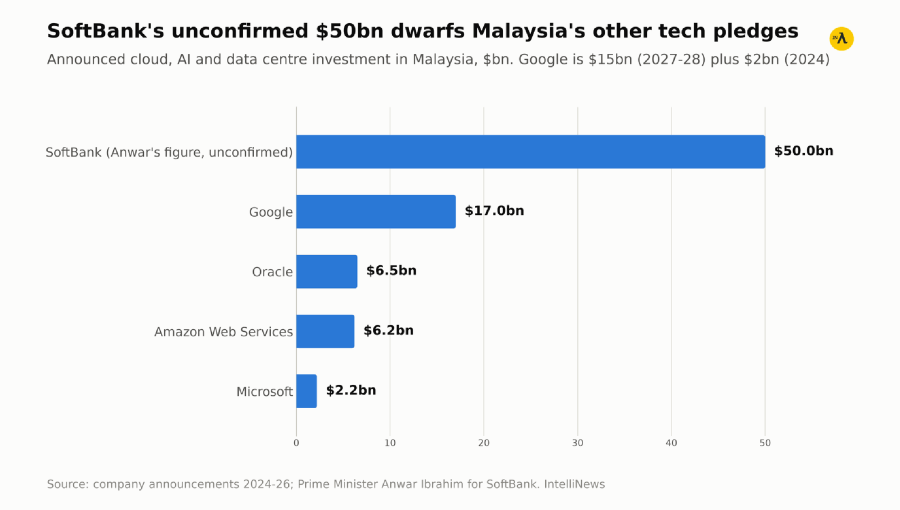
Google pledged a further $15bn for Malaysian data centres on November 4, a day before a Wall Street rout blamed partly on fears of a US crackdown on AI.
Alphabet says in a company statement that the money covers 2027-28, on top of $2bn announced in May 2024, and goes to its Elmina campus in Selangor and new sites in Selangor and Negeri Sembilan. A far larger number rests on one man's word: SoftBank founder Masayoshi Son intends to invest $50bn in Malaysia, IntelliNews reported, citing Prime Minister Anwar Ibrahim's account of a videoconference. SoftBank has not confirmed the figure or any terms.
Announced cloud, AI and data centre investment in Malaysia. Source: company announcements; Prime Minister Anwar Ibrahim for SoftBank. IntelliNews.
Fear of Democrats in Washington is the wrong yardstick for that pipeline. The measures on the table in Washington are aimed at American sites and American tax breaks, while Malaysia's exposure runs through the balance sheets of the companies writing the cheques, US export controls on chips and its own stretched grid. The US was the largest source of approved foreign investment in 1H26 at MYR33.1bn ($8.2bn) and Japan the third at MYR22.3bn ($5.5bn) [1].
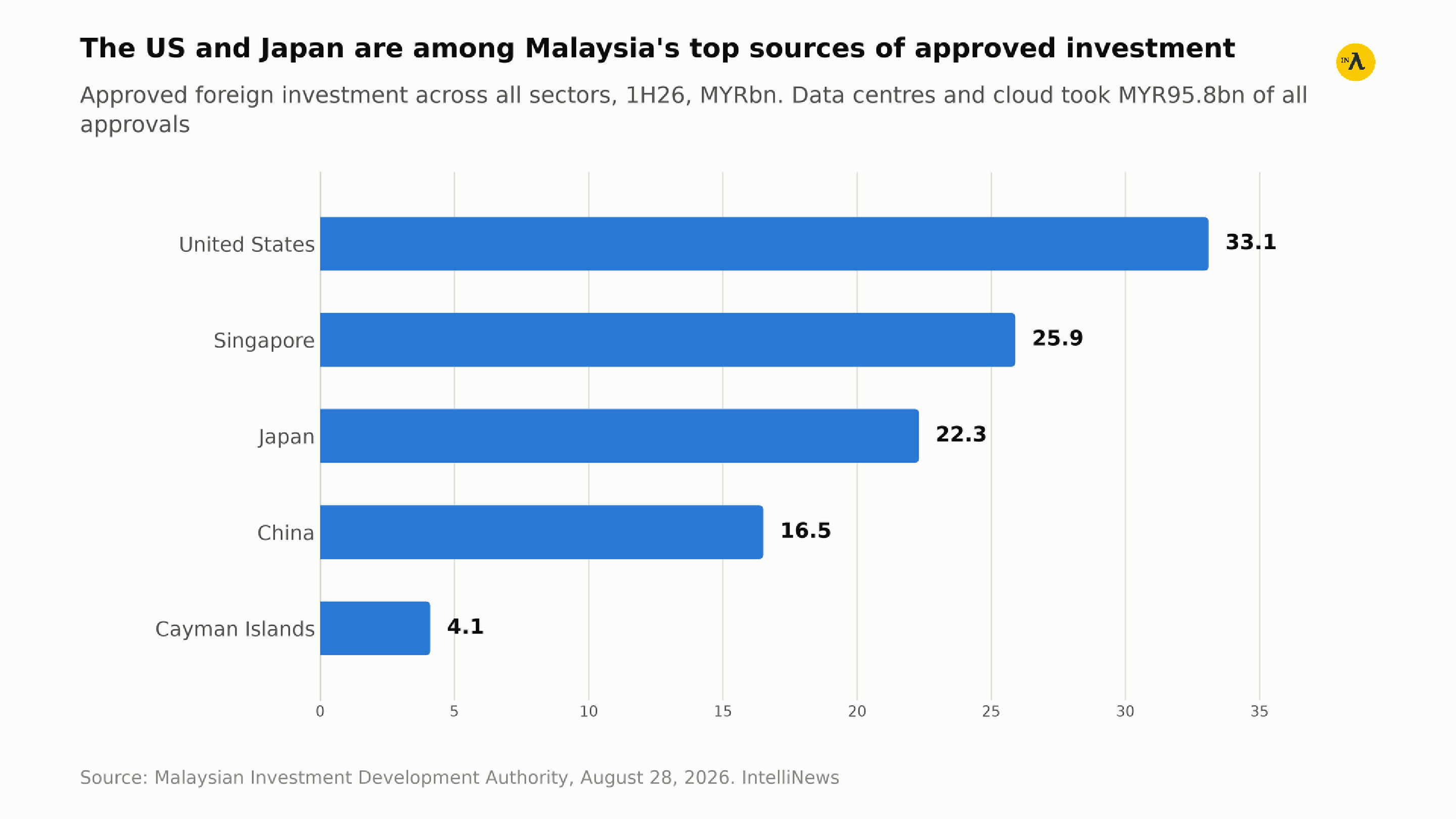
Approved foreign investment by source, all sectors, 1H26. Source: Malaysian Investment Development Authority. IntelliNews.
Hearings, not bulldozers
Tech shares slid after the midterms on fears that the Democrats' victory would bring tighter scrutiny of AI and slower data centre building, Al Jazeera reported on November 6. Before the vote, analysts told Reuters that a law halting construction looked unlikely. "There will be congressional hearings. There will be investigations," said Brian Gardner, chief Washington policy strategist at Stifel. President Donald Trump would probably block anything that seriously impeded expansion, according to Matt Gertken of BCA Research.
A planning fight in Texas or Ohio binds nobody in Kuala Lumpur, and a host government still issuing approvals could look more attractive for it. Money is the weaker flank. SoftBank shares lost 11% on November 6, and the same company is already developing a $500bn project in Ohio. Tokyo has its own claim on Japanese capital: cloud computing and AI data centres rank among the priorities in Japan's 17-sector growth strategy, Nikkei Asia reported the same day. Spending on AI infrastructure was expected to top $1 trillion next year, Reuters reported in October, and that sum now looks open to question. "We're spending money a bit too quickly," Toby Walsh, chief scientist at the AI Institute of the University of New South Wales, told Al Jazeera.
Washington's firmest grip on Malaysia predates this election. High-performance US chips have needed a permit to leave or transit the country since July 2025, and customs seized 30 AI servers worth MYR49.5mn ($12.2mn) at Kuala Lumpur airport in October, the fifth case this year tied to one syndicate, IntelliNews reported. Earlier US pressure, together with grid and water limits, slowed the build-out last year.
Paying for the privilege
Kuala Lumpur's own terms are hardening faster. The 57 operating data centres require 6,237 MW and another 60 projects could add 11,172 MW [2], a combined 17.4 GW against forecast national peak demand of 21.3 GW this year [3]. Actual load was only 1,256 MW in June, IntelliNews reported, citing Tenaga Nasional. An operator reserving 200 MW and using 100 MW will now be billed for the rest. "We welcome them to come, but it is not about getting cheap energy from us," Investment, Trade and Industry Minister Johari Abdul Ghani told parliament on October 15.
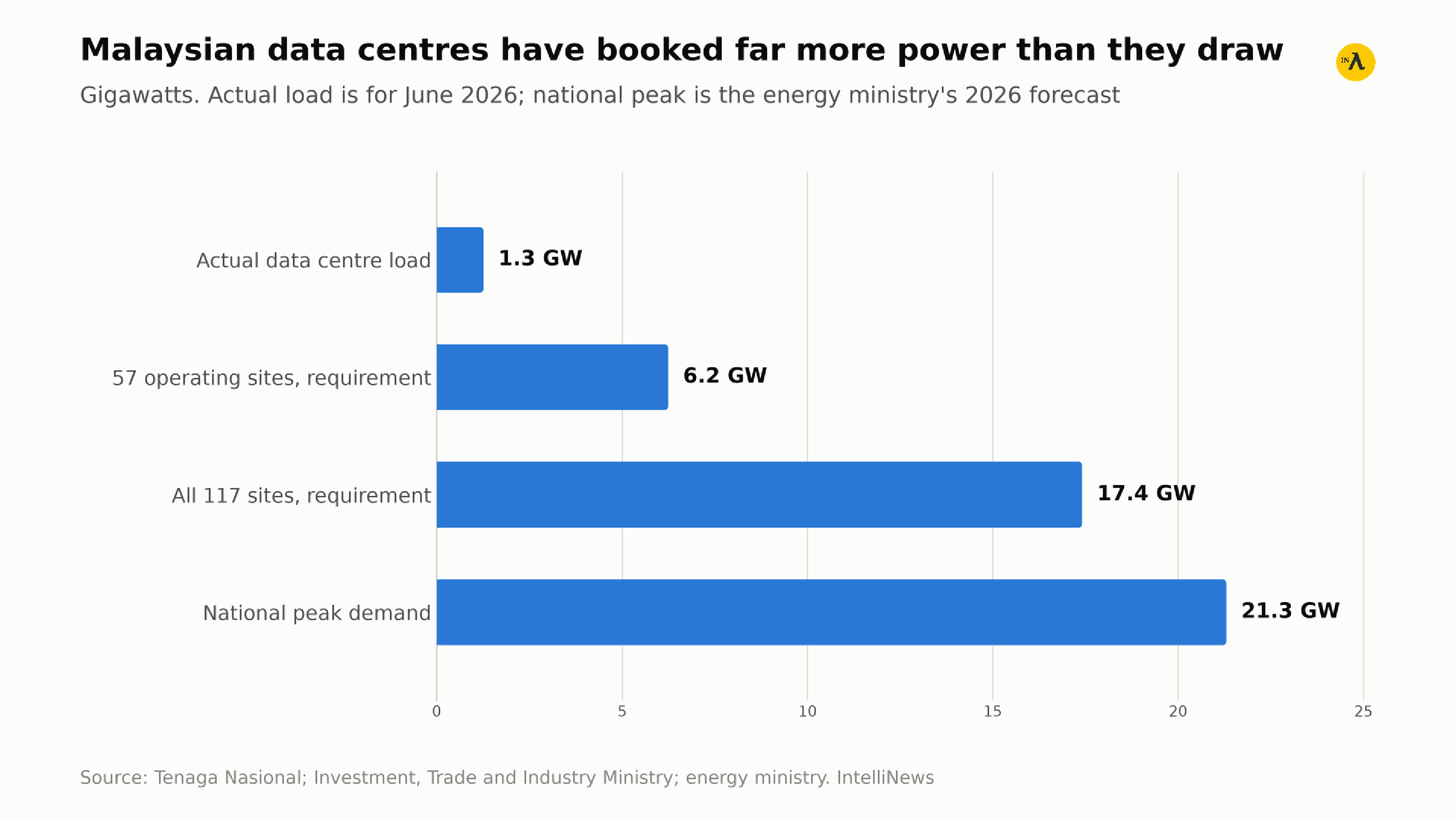
Malaysian data centre power requirements against actual load and national peak demand. Source: Tenaga Nasional; Investment, Trade and Industry Ministry; energy ministry. IntelliNews.
Google has accepted that bargain, promising to pay for all the power its campuses use, plus their grid connections, and to bring more than 1 GW of new clean capacity. Malaysia has also stopped approving non-AI data centres. Water may bite first: BIMB Securities estimates Selangor can absorb only about 60mn litres a day of extra data centre demand over 2027-29, against a projected 632mn, IntelliNews reported.
Approved is not built
Data centres and cloud took MYR95.8bn ($23.7bn), or close to 44%, of all investment approved in 1H26 [1]. Approvals since 2021 total MYR385.7bn ($95.2bn), and Johari noted that not all of it has been realised [2]. Of 27 projects worth MYR225.97bn ($55.8bn) cleared by the national data centre task force up to July, one is running [4].
Google's jobs promise needs the same discount. Its 37,000 jobs a year over 2027-28 include about 6,000 in construction, and it projects 9,000 once the campuses run. The sell-off tells us how investors feel this week. The harder evidence arrives with the 2027 tariff review, and on the day SoftBank puts a number in writing.
Sources
[1] Malaysian Investment Development Authority, approved investments, 1H26, published August 28, 2026
[2] Investment, Trade and Industry Ministry, data centre power requirements and approvals since 2021, statement to parliament, October 15, 2026
[3] Energy ministry, forecast peak electricity demand for 2026, as reported by IntelliNews, November 4, 2026
[4] Digital Ministry, Data Centre Task Force approvals to July 2026, written reply to parliament, October 14, 2026
This article was produced with the help of the IntelliNews Lambda analytical tool

No comments:
Post a Comment